Why Custom Drapery is the Ultimate Finishing Touch in Interior Design
The Room Was Almost Perfect
You've chosen the sofa, found the rug, hung the art. The room looks good, maybe even great. But something is missing. The walls feel exposed. The light is harsh at certain hours. The space doesn't quite breathe the way you imagined.
Nine times out of ten, the missing element is the window treatment. And not just any treatment, custom drapery.
There's a reason every great interior designer finishes a room with the windows. Drapes are the frame through which we experience a space. Get them right, and they pull the entire room together like a final brushstroke on a painting. Get them wrong or skip them entirely and the room never quite reaches its potential.
What Makes Custom Drapery Different
Walk into any big-box retailer and you'll find curtains in a handful of standard lengths, a limited range of fabrics, and hems that almost — but not quite — reach the floor. Custom drapes are a different proposition entirely.
Custom drapery is designed around your specific window dimensions, your ceiling height, your light requirements, and your aesthetic vision. Every panel is cut, lined, and sewn to order. The result isn't just a better-looking curtain. It's a window treatment that looks as though it has always belonged in that room because, in a sense, it was made for it.
The difference shows immediately. Custom drapes hang with a weight and evenness that ready-made curtains struggle to achieve. The fabric pools at exactly the right point, or brushes the floor with exactly the right break. Nothing bunches awkwardly. Nothing hangs short.
The Three Pillars of Exceptional Custom Drapes
Fabric. The material you choose determines everything: how light filters through the room, how the drape falls, how the color reads at different times of day. Linen gives a relaxed, organic elegance. Velvet commands attention and absorbs sound. Sheer fabrics layer beautifully with blackout panels for a look that's both functional and refined. The right fabric doesn't just cover a window, it changes the mood of the room.
Fullness. One of the most common mistakes in window dressing is under-budgeting fabric. Designer drapery is full, typically 2 to 2.5 times the width of the window — so that when panels hang, they have genuine body and movement. Thin, flat panels look sparse regardless of how expensive the fabric is. Fullness is what creates that lush, gathered look that signals quality.
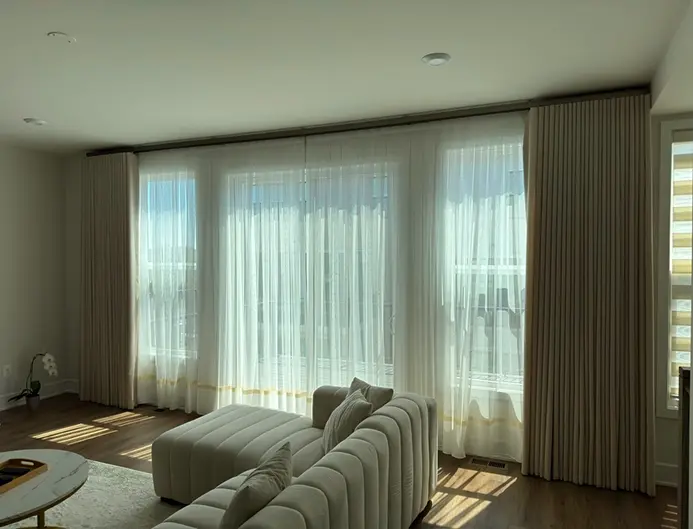
Length. Where the hem lands is one of the most consequential decisions in a room's design. Drapes that hover above the floor interrupt the vertical line of the wall and make ceilings feel lower. Custom drapes hung high close to the ceiling and falling to the floor, or even puddling slightly beyond it, draw the eye upward and make any room feel taller, more expansive, and more luxurious.
Beyond Aesthetics: The Practical Case for Custom Drapery
Beautiful as they are, custom drapes earn their place on practical grounds too. Lined drapery significantly reduces heat loss in winter and keeps rooms cooler in summer, lowering energy costs in a way no sheer curtain can. Blackout-lined custom drapes create genuine darkness in bedrooms particularly valuable in urban homes or rooms facing east. Heavyweight custom drapes also provide a meaningful layer of acoustic insulation, softening noise in open-plan living spaces.
These aren't incidental benefits. They're built-in features of well-made, custom-fitted window treatments and they compound the value of the investment over time.
A Word on Investment
Custom drapery costs more than ready-made curtains. That's simply true, and there's no point pretending otherwise. But the comparison isn't quite fair. Ready-made curtains are a commodity; custom drapes are a bespoke product made to last decades, not seasons. They don't fade in and out of relevance the way trend-led accessories do. A beautifully made linen drapery panel, hung well, will look as considered in fifteen years as it does the day it's installed.
For homeowners who are finished with temporary solutions and ready to invest in the room they actually want to live in, custom drapery is rarely regretted.
FAQ
Q1: How is custom drapery measured and installed? A specialist measures your window width and ceiling height precisely, then calculates the fabric quantity needed for proper fullness. Panels are cut to length and hemmed to order. Installation involves fitting brackets at the correct height typically 4–6 inches above the window frame, or closer to the ceiling for a dramatic effect and hanging the finished panels. Working with a professional installer ensures the result looks as intended.
Q2: What's the difference between lined and unlined custom drapes? Lined drapes have an additional layer of fabric sewn to the back of each panel. This lining improves the hang of the drape, protects the face fabric from sun damage, adds insulation, and with a blackout lining blocks light entirely. Unlined drapes are lighter and more casual in appearance. For most living rooms and bedrooms, a standard or blackout lining is worth the added cost.
Q3: How long does it take to have custom drapery made? Lead times vary by supplier and fabric availability, but most custom drapery orders take between 4 and 8 weeks from fabric selection to installation. If you're working to a deadline, a move-in date, a renovation finish it's wise to begin the process early.
Q4: Can custom drapes work in a rental property? Yes. Custom drapes are hung on removable rods and brackets, which means they can be taken down and reinstalled in a new property. If you invest in a quality set of custom drapes sized for a standard ceiling height, they'll likely work again in your next home. They're one of the more portable luxury investments in interior design.
Q5: How do I choose between sheer and opaque custom drapes? It depends on the room's purpose and your light preferences. Sheer custom drapes filter light beautifully, maintain a sense of connection to the outdoors, and work well in living and dining rooms. Opaque or blackout-lined custom drapes are better suited to bedrooms or media rooms where light control is the priority. Many designers layer both, a sheer panel closest to the window with a heavier drape on the outer rod for maximum flexibility.
Q6: Are custom drapes suitable for large or unusually shaped windows? This is precisely where custom drapery excels. Off-the-shelf curtains are designed for standard window sizes; custom drapes are made for yours. Wide windows, floor-to-ceiling glazing, bay windows, and awkward alcoves all benefit from the tailored approach that custom drapery provides.
The finishing touch your windows have been waiting for. Explore custom drapery at Brilliant Blind →