Roller Shades vs. Roman Shades: Which Is Better for Modern Homes?
Introduction: Two Styles, Different Priorities
Roller shades and Roman shades both do the same basic job. They cover windows, manage light, and provide privacy. Where they differ is in how they look doing it, and those differences matter depending on the room.
Roller shades disappear when you don't need them. Roman shades stay visible and add to the room's character even when fully raised. Neither is universally better. The question is which trade-offs make sense for your space.
What Each Style Actually Is
A roller shade is a single piece of fabric that rolls up into a compact headrail. The mechanism is simple, and the profile is minimal when raised; there's almost nothing to see.
A Roman shade folds into soft horizontal pleats when raised. The fabric stays visible and structured, closer in feel to a soft drape than a traditional blind. It adds texture even when open.
Both are available as custom window shades, meaning you can specify fabric, opacity, and operating system rather than being limited to standard sizes and materials.
Design Differences
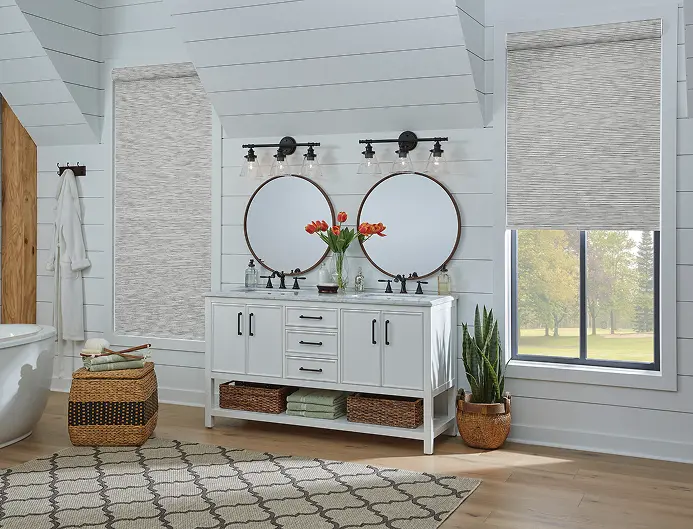
Roller shades work well in modern and contemporary interiors because they don't compete with the rest of the room. Clean edges, flat surface, minimal visual presence. In a room with strong architectural features or carefully chosen furniture, a roller shade stays out of the way.
Roman shades add something to a room rather than receding from it. The soft folds introduce texture and movement. They work well in bedrooms, living rooms, and spaces where the window treatment is part of the design rather than a functional afterthought. They suit traditional, transitional, and softer contemporary styles better than strictly minimalist ones.
Light Control
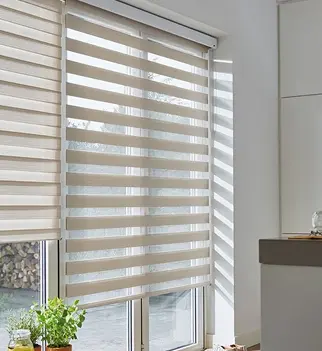
Roller shades offer precise, adjustable control. Fabric choice determines performance: sheer fabrics diffuse light while preserving visibility, light-filtering fabrics reduce glare without darkening the room, and blackout fabrics block light almost entirely. You can stop the shade at any position and get a consistent result.
Roman shades handle light well but more softly. Even a blackout-lined Roman shade has a slightly diffused quality due to the layered fabric structure. That's not a flaw; it suits rooms where atmosphere matters more than precision. But if you need reliable blackout performance with clean edges, roller shades are more consistent.
Daily Use and Operation
Roller shades are built for easy, frequent use. The mechanism is smooth, the profile stays compact, and they integrate easily with motorized systems. In high-traffic rooms, kitchens, home offices, and kids' rooms, simplicity holds up over time.
Roman shades operate more deliberately. The folding mechanism works fine, but it isn't quite as quick or precise. They're better suited to rooms where you don't need to adjust them multiple times a day.
Maintenance
This is where the practical gap between the two is most noticeable.
Roller shades are easy to clean, with a flat surface that can be wiped down or spot-cleaned without much effort. Dust doesn't collect the way it does in folds.
Roman shades require more attention. The pleated structure traps dust, and depending on the fabric, they may need occasional steaming to hold their shape. In a household with kids, pets, or high activity, that adds up. In a bedroom or formal sitting room where the shades aren't handled constantly, it's less of an issue.
Energy Efficiency
Both styles can be fitted with thermal or blackout liners that improve insulation and reduce heat gain. The difference is modest. Roman shades add a layer of fabric by default, which provides slightly more insulation than an unlined roller shade. But with the right liner, either option performs reasonably well for energy purposes.
If insulation is the primary concern, cellular shades are worth comparing against both.
Room-by-Room
Living rooms: Either works, depending on the overall aesthetic. Roller shades in more minimal rooms, Roman shades where you want softness and texture.
Bedrooms: Blackout roller shades provide reliable sleep. Roman shades with blackout lining work too, but the softer edge means slightly more light bleeds at the folds. For serious light blocking, roller shades have the edge.
Kitchens: Roller shades in moisture-resistant fabrics are the more practical choice. Roman shades in a kitchen accumulate grease and steam more noticeably.
Home offices: Roller shades handle glare more predictably, which matters when you're managing screen visibility throughout the day.
Mistakes Worth Avoiding
Treating window treatments as a finishing touch rather than a functional decision. Choosing fabric based on appearance without checking opacity or performance specs. Not accounting for how light changes throughout the day in the room, a fabric that looks right at noon can be inadequate at 4 p.m. when the sun angle shifts. And buying standard sizes when the window dimensions don't quite match, which affects both performance and appearance.
How to Choose
If the room calls for clean lines, easy operation, and reliable light control, then roller shades are the way to go. If the room benefits from softness, texture, and a window treatment that contributes to the design rather than disappears, Roman shades are a good choice.
For rooms where you genuinely want both, layering is an option: a roller shade behind a lightweight curtain panel, or a Roman shade with a sheer roller behind it for daytime diffusion.
Why Custom Sizing Matters
Standard sizes rarely fit well. Gaps at the edges compromise light control and make the space look unfinished. Custom window shades are sized to the actual window, which improves both performance and appearance. Custom ordering also lets you specify fabric weight, opacity, and operating system for your specific conditions rather than working around whatever's in stock.
How Brilliant Blind Can Help
Brilliant Blind works through the practical side of decision-making: window orientation, room function, and fabric performance, and helps match the right treatment to the right space. Whether you're looking at roller shades, Roman shades, or a combination, the goal is to find something that actually works for how the room gets used.
Conclusion: Pick the One That Fits the Room
Roller shades and Roman shades solve the same problem in different ways. One prioritizes function and simplicity; the other prioritizes texture and visual presence.
The decision is less about which is objectively better and more about what the room actually needs and which trade-offs you're willing to make.
FAQ
1. Which is better for modern homes: roller shades or Roman shades?
Roller shades fit minimalist and contemporary aesthetics more naturally. Roman shades work better in rooms with softer, more layered design, traditional, transitional, or warm contemporary styles.
2. Do roller shades fully block light?
Blackout roller shades do, provided they are installed properly with minimal side gaps. The flat fabric surface produces a cleaner blackout than pleated alternatives.
3. Are Roman shades outdated?
No. They've stayed relevant because they add something to a room that flat treatments don't. The style has evolved, but the appeal hasn't changed much.
4. Which is easier to maintain?
Roller shades: the flat surface is easier to clean and doesn't trap dust the way pleated fabric does.
5. Can both be motorized?
Yes. Both integrate well with motorized systems, though roller shades are somewhat more common in motorized applications because they are adjusted more frequently.
6. Are custom window shades worth the cost over standard options?
For most windows, yes. A proper fit improves light control, reduces gaps, and makes it look more finished. The performance difference is more noticeable than most people expect.