How to Use Window Treatments to Create Privacy Without Blocking Views
How Window Treatments Balance Privacy and Outside Views
Glass behaves like a one-way mirror that flips with the sun. During the day, the outdoors is brighter, so light-filtering fabric hides your interior while you still see the yard. After sunset it reverses: turn on a lamp, and the street can see in.
People walking by look in at eye level, rarely through the top third of the window. You rarely need to cover the whole pane, only the part that lines up with the sidewalk or the neighbor’s deck.
Sheer Shades for Soft Privacy and a Clear View Out
Sheer shades hold soft fabric vanes between two layers of sheer knit. With the vanes open, you look out through a fine gauze. Close them, and daylight spreads evenly across the room, while your living room looks like a soft blur from the street. Custom sheer drapery gives a looser version of the same effect.
Solar Shades and Banded Shades for Daytime Privacy
Solar Shades and Openness Factor
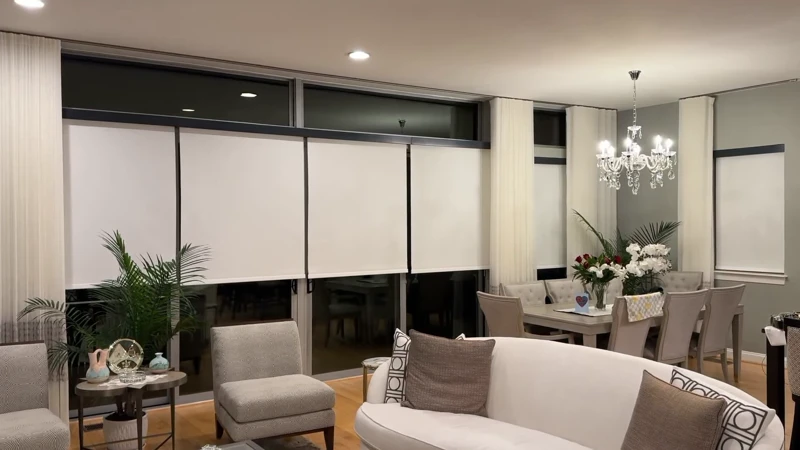
Solar shades are rated by openness, the percentage of the weave left open. At 1% to 3%, you get more daytime privacy and better glare control. At 5% or 10%, the view is crisper but more of the room shows. Darker colors usually look clearer from inside than light ones.
Banded (Zebra) Shades for Adjustable Coverage
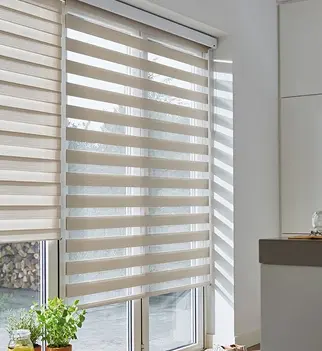
Banded shades alternate sheer and solid stripes. Line up the sheer stripes when you want the view, and shift them so the solid bands overlap when you don’t.
Top-Down/Bottom-Up Shades for Street-Level Privacy
Lower the top rail and raise the bottom, and the sidewalk drops out of sight while the sky and treetops stay. Townhouse front rooms are the classic use, along with bathrooms. In cellular fabric, you also get some insulation.
Privacy Blinds That Let You Angle the View
Think of each slat as a tiny awning. Tilted up, it shows outside eyes nothing but its underside, while daylight bounces onto your ceiling. Faux wood blinds shrug off bathroom humidity. On patio doors, vertical blinds or sliding panels stack to one side.
Layering Window Treatments for Day and Night Privacy
Sheer and solar fabrics turn see-through after dark, so the setup that works around the clock uses two layers:
-
A sheer or solar shade for daytime light and the view
-
Drapery or a light-filtering shade you close at night
On windows right at street level, a café-height panel across the lower half adds coverage that never has to move.
Motorized Privacy Blinds That Adjust on Schedule
Motorized shades can lower at sunset and rise in the morning on their own. That helps most on the window facing the neighbor, since it’s the easiest one to forget.
Choosing Privacy Window Treatments Room by Room
Sheer or banded shades under drapery handle most living rooms. Bedrooms need something for nighttime, either a drapery layer or a top-down/bottom-up shade. Home offices are their own case. There, a 3% solar shade cuts monitor glare and keeps the backyard visible behind you on video calls. For bathrooms, faux wood or top-down cellular is the usual answer.
Openness and sheerness are hard to judge from a photo. Samples look different in real daylight, so it’s worth seeing them at the Brilliant Blind & Design showroom at Fair Oaks Mall in Fairfax or booking a free in-home consultation.
Frequently Asked Questions
1. Can people see through sheer shades at night?
Yes, if the lights are on inside and the vanes are open. Closing the vanes helps some. For real nighttime privacy, add drapery.
2. What openness factor is best for privacy with solar shades?
1% to 3%.
3. Which window treatments give privacy in a bathroom without blocking light?
Top-down/bottom-up cellular shades, since they cover eye level and leave the top open. Faux wood blinds also work and won’t warp from shower steam.
4. Are top-down/bottom-up shades worth it for street-facing windows?
For most townhouses, yes. It’s the simplest way to hide the sidewalk without giving up the sky.
5. Do privacy blinds work on sliding glass doors?
They do. Vertical blinds and sliding panels are made for wide openings and stack clear of the door.