Choosing the Right Drapery Hardware for Your Home’s Aesthetic
Drapery hardware should not be treated as the equivalent of the final period on a work of writing. In writing, the period signifies the end of a piece, but in drapery, the ‘period’ signifies drapery hardware hold functionality that isn’t a feature of writing. It helps correct drapery and perform drape, and it endows the room with a finished feeling, versus simply looking like an afterthought.
Drapery sewing professionals tend to have an eye for drapery hardware. Where there are drapery sewing professionals who add drapery hardware, the difference between a polished drapery look and an ugly drapery look is drapery hardware.
Knowing the Definition of Drapery Hardware
To begin with, drapery hardware is more than a style rod. It is a complete subsystem consisting of a style rod, fabric track or drapery rod, track or rod brackets, decorative end pieces or rod caps, decorative or functional rings and glides, and mounting hardware that work collectively to hold a decorative or functional fabric and control the fabric movement. All pieces take on a specific role, but neglecting one piece can render the system as a whole useless.
Good systems of drapery hardware maintain a system of control to enable the draping fabric to traverse the rod or track, keep the fabric hung straight, and retain control of its form. Thin systems of drapery hardware eventually self-reveal with a drapery that sags.
How to Choose Drapery Hardware to Match Your Home's Style
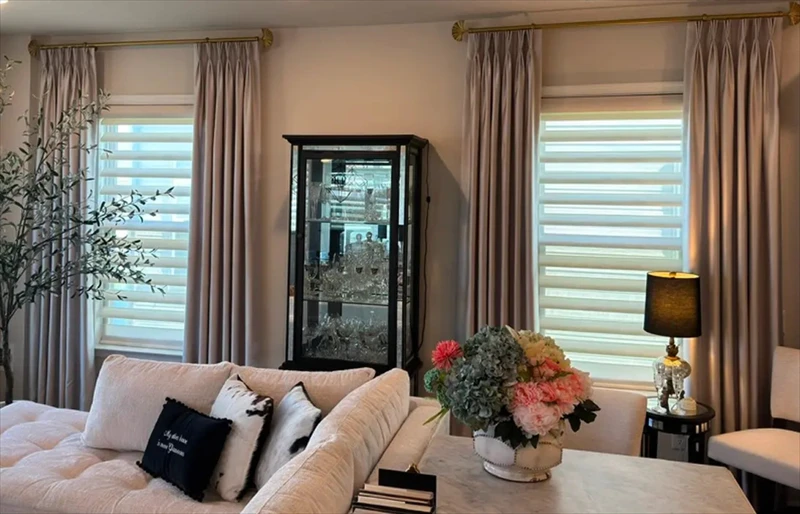
Every home has its own style, and the style can be formal, relaxed, modern, or traditional. Drapery hardware can, and should, fit the style of the home exactly. In traditional style interiors, slim drapery rods and simple finials match the windows and furnishings. In modern interiors, drapery hardware is simple and sleek. A drapery rod with a finial can also match and complement the window’s decor. Home styles with a mix of different styles, called transitional style, work well with drapery hardware that has a simple design and some embellishments. Cohesion is the main goal. Drapery hardware should look like a part of the room and fit with the design instead of looking like an afterthought.
Different Options of Drapery Hardware and What They Look Like
Drapery tracks and drapery rods look different and have different functions. A drapery rod is more of a design feature and is visible, and a drapery track is more functional and is out of sight. A window can be framed by a decorative rod that has a finial for an intentional design, and a simple rod or track can be used to let the fabric be the main decoration.
There is no one correct answer for what drapery hardware to use. If the windows are the main feature of the room, decorative rods can be a good choice. If the room has a lot of visual design elements, a simpler drapery system works well.
Picking the Right Finish for Drapery Hardware
The finish for the hardware is often the most intimidating but also the most useful element for homeowners. Drapery hardware finishes should match the metals already in the room, such as the lighting, door handles, and furniture accents. If you want a warmer finish, choose rich and soft brass or bronze. If you want a cooler finish, pick one that brings contrast and modernity, such as chrome or black.
It is more important to be consistent than to color-match. You want to not have hardware that is copied from other metals, but rather one that complements the other metals in the room.
Easily the most major flaw is choosing drapery hardware that is not the right size. It is way too easy to pick thin rods for wide or tall windows. In the end, choosing poorly sized drapery hardware will have the entire space looking underwhelming, regardless of how beautiful the fabric is.
Appropriately sized hardware will help to frame the window and give the room a sense of confidence that it wasn’t lacking. It will not shy away or undervalue the window, but rather embrace it.
When Function And Aesthetics Must Agree
If something is beautiful and serves no purpose, it will not endure. Drapery hardware needs to be able to handle the weight of the curtains and allow for movement that is smooth and easy. Heavier drapes require the use of sturdier rods, stronger brackets, and appropriate spacing. Lightweight panels allow for the use of more flexible systems, but still benefit from systems of good quality.
Convenience and accessibility are especially important for large or hard-to-reach windows. Motorised and traversed hardware options are great for these scenarios. Function is the priority, and they are certainly not ugly.
Considerations for Each Room
In living rooms, decorative window coverings are often the most appropriate, especially if the window is large. Neutral, simple, and unobtrusive styles are the go-to for kitchens and serving spaces. Quiet operation and smooth movement are what drapery hardware needs to support for bedrooms, as comfort and privacy are priorities. Drapery hardware should be responsive to the unique relationship each room has to its windows.
Standard versus Custom
Standard hardware options are great for most situations and integrations, primarily when the proportions work. Custom Drapery hardware is useful when the windows are oversized, there are high ceilings, or when the finishes need to be matched very closely. There is a lot of room to create a unique design with custom options, but it is still possible to create a very intentional, sophisticated look with standard options when drafted with care. In the end, it is a question of balancing your budget, design goals, and the functionality you need over time.
The Importance of Getting Professional Help
The longevity of drapery hardware depends on how accurate the measurement, placement, and installation of the pieces are, and professionals will consider the wall structure, behavior of the fabric, and visual alignment before installing the first bracket, so issues that can arise months post installation are avoided. It's a good idea to pair good drapery hardware with good installation.
FAQ
1. Why is drapery hardware so important to the overall look of a room?
Because over-functioning, drapery hardware functions as the frame of the window, so professionals consider it a major element of room design instead of a minor detail.
2. Should drapery hardware match other metal finishes in the room?
No. It should coordinate, but not match exactly, so that visual harmony can be made to the space's mood of the room without it feeling repetitive.
3 . How do I know what rod size to choose?
The rod diameter needs to be proportional to the window width, as well as the height of the ceiling and weight of the fabric, so that it doesn’t look weak or unbalanced.
4. Is motorised drapery hardware worth considering?
Absolutely, especially for big windows, high ceilings, and for visual accessibility, as it adds usability without colliding with the overall design.
5. Can I reuse old drapery hardware with new curtains?
Sometimes yes, but only if the new fabric and design can be properly supported by the hardware, and the updated aesthetic aligns it takes a bit of balancing to pick the correct drapery hardware. When something looks balanced, polished, and finished, it often takes a good amount of work on the back end. When it comes to designing the window’s treatments, you don’t want to leave the hardware to the end of the process. The hardware is the support for the window treatment, and it is what helps all the other design features stand out.